

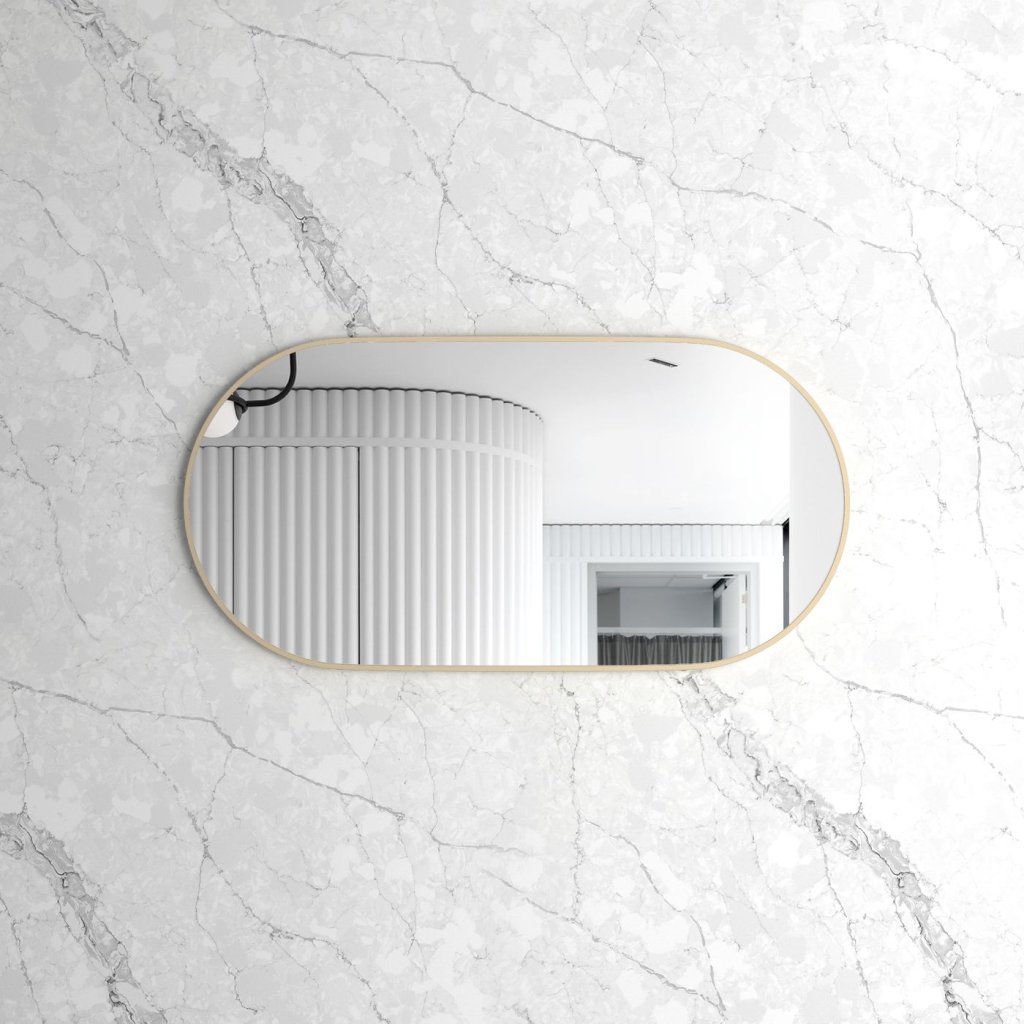
An LED mirror is not automatically a better choice than a standard mirror. The right option depends on the lighting plan, electrical work, installation location, maintenance strategy and the way the bathroom will be used. For a homeowner, the decision may be mainly about convenience and appearance. For a hotel, apartment programme or retail range, consistency, compliance evidence and serviceability can matter just as much as the feature list.
This guide compares LED and standard bathroom mirrors without assuming that one format suits every project. It is intended for designers, contractors, importers, developers and buyers who need to define a clear specification before requesting quotations or approving samples.
What Is the Difference?
A standard mirror has no integrated powered lighting or electronic functions. It may be frameless or framed and can be used with ceiling lights, wall sconces or a separate vanity light. Its simplicity is often an advantage where electrical access is limited or where the lighting designer wants complete freedom to position other luminaires.
An LED mirror integrates an LED light source, a driver and an electrical connection into the mirror assembly. It may be front-lit, edge-lit, backlit or combine more than one lighting effect. Optional functions can include dimming, selectable colour appearance, touch or sensor controls and a heated demister area.
The term smart mirror is used inconsistently in the market. For some suppliers it simply means an LED mirror with a touch switch. For others it may include a clock, Bluetooth audio or other connected functions. Buyers should therefore compare the exact configuration rather than relying on the product name. ArcQuay’s LED mirror overview provides a starting point for reviewing available formats.
LED Mirror vs Standard Mirror: Quick Comparison
| Decision area | Standard mirror | LED mirror |
|---|---|---|
| Lighting | Depends on separately specified room or vanity lighting. | Provides integrated light, but may still need supporting room lighting. |
| Electrical planning | No power is needed for the mirror itself. | Requires a suitable supply, switching method and installation by an appropriately qualified person. |
| Fog management | No active demisting unless another solution is added. | Can include a heated demister area when specified. |
| Installation | Generally fewer interfaces, although wall structure and safe mounting still matter. | Requires coordination of brackets, cable exit, driver location, wall clearances and electrical access. |
| Maintenance | Few components and straightforward replacement. | Includes electrical parts; access, spare components and replacement strategy should be reviewed. |
| Design control | Allows lighting and mirror shape to be specified independently. | Creates an integrated appearance and can combine several functions in one assembly. |
| Compliance scope | Mainly concerns safe glass, mounting and any separately installed lighting. | Also requires review of the complete electrical configuration and evidence applicable to the target market. |
1. Start With the Lighting Plan
The most useful question is not “Does the mirror have LEDs?” but “What lighting task must the mirror support?” Face lighting for grooming needs to be assessed differently from decorative backlighting. A backlit mirror can create an attractive halo on the wall while providing limited forward light. A front-lit or edge-lit design may illuminate the face more directly, but its performance still depends on the mirror size, LED position, diffuser, wall colour and surrounding light.
Do not assume that an LED mirror will replace all bathroom lighting. General illumination, shower or bath zones and circulation areas may require separate luminaires. For a standard mirror, the designer can position sconces or a vanity light specifically for the room. For an LED mirror, ask the supplier to state the lighting arrangement, declared colour characteristics, dimming method and any available photometric information. Evaluate a sample in conditions that resemble the intended room rather than judging it only from a catalogue image.
2. Coordinate Power, Switching and Mounting Early
A standard mirror is often the easier retrofit because the mirror itself does not need power. That does not make installation automatic: the wall construction, mirror weight, bracket design, fixing points and clearances must still be suitable. Separate luminaires also need their own electrical plan.
An LED mirror needs coordination before the wall is closed. Confirm the supply voltage and frequency, hardwired or plug-in connection, cable exit position, driver location, switching logic and access for future service. The installer also needs an accurate dimensioned drawing showing the overall projection and mounting points. Local electrical and building requirements determine who may install the product and where it may be positioned. A supplier drawing is useful project information, but it does not replace local design approval or qualified installation.
3. Treat Bathroom Suitability as a Technical Question
Moisture exposure varies within a bathroom. The product location, distance from water sources, ventilation, installation orientation and local zone rules all affect suitability. A standard mirror has no integrated electrical parts, but its backing, frame, fixings and edges should still be appropriate for the environment.
For an LED mirror, request the declared ingress-protection code and the evidence supporting that claim for the exact model and configuration. An IP code describes tested protection against specified solid objects and water exposure; it is not a blanket statement that a product is “waterproof.” In particular, IP44 should not be described as waterproof. It also does not by itself determine whether a mirror is permitted in a particular bathroom location. The installer and project team must check the applicable rules for the destination market.
4. Compare Maintenance and Serviceability
The standard mirror has an obvious advantage in component simplicity. If a separate light fails, the light can usually be serviced without replacing the mirror. This can be valuable in rental portfolios, remote projects or properties that prioritize common replacement parts.
An LED mirror combines the mirror and powered components, so buyers should look beyond the appearance of the sample. Ask whether the driver and controls are accessible, which components are replaceable, how components are identified, what spare-part support is available and whether a change in driver or LED module requires buyer approval. For multi-unit projects, the ability to hold compatible spares and identify the installed version may be more important than adding another feature.
5. Specify Functions That Users Will Actually Need
Dimming, selectable colour appearance, memory, touch controls, motion sensors and demisting can improve the user experience, but none is universally essential. A hotel may prefer a simple, clearly labelled control that guests understand immediately. A residential buyer may value dimming and last-setting recall. A commercial washroom may prioritize robust operation and easy maintenance over multiple modes.
A demister is also a defined component, not a promise that the full mirror will remain clear in every condition. Ask for the pad size and position, control logic and an agreed test method. Its result will depend on the heated area, room temperature, humidity, ventilation and operating time. If a function is not important to the brief, removing it can simplify approval and service.
6. Compare Total Installed Scope, Not Advertised Unit Price
There is no reliable universal price comparison. Mirror size, glass, edge treatment, frame, lighting configuration, driver, controls, packing and order quantity all influence the quotation. Local labour and electrical work can change the installed cost again.
For a fair comparison, price two complete scopes. A standard-mirror scope may include the mirror, brackets, separate vanity lighting, switching and installation. An LED-mirror scope may include the integrated unit, power provision, controls, mounting, testing and an agreed spare-parts allowance. For B2B procurement, also consider sample development, compliance documentation, packaging, replacement access and the cost of holding more than one product version. Avoid using a low unit price to hide an incomplete technical scope.
When a Standard Mirror Is the Better Fit
- The existing wall has no practical power provision for the mirror.
- The design uses carefully positioned decorative or architectural lighting.
- The property needs the simplest possible replacement and maintenance plan.
- A heritage, traditional or highly decorative frame is central to the design.
- The buyer wants mirror and lighting suppliers to remain independent.
- A retrofit must avoid opening walls or changing the electrical layout.
When an LED Mirror Is the Better Fit
- The project wants an integrated, visually clean lighting feature.
- Power and mounting details can be planned before installation.
- Defined task lighting or a decorative halo is part of the design brief.
- A specified demister area would be useful for the expected room conditions.
- A hotel, showroom or residential range needs a coordinated mirror family.
- The buyer can approve samples, technical documents and component controls before bulk production.
Project Guidance for B2B Buyers
Hotels and hospitality
An LED mirror can support a contemporary guest-room concept, but intuitive controls, repeatable light appearance and service access should take priority over novelty. Confirm how the mirror behaves after a wall switch or room-control system restores power. Keep the approved control layout consistent across rooms.
Apartments and multi-unit developments
Standard mirrors can simplify long-term replacement, while LED mirrors can reduce the number of visible wall fittings and create a coordinated specification. Either approach can work. The key is to standardize dimensions, mounting, electrical interfaces and approved components across the project.
Showrooms and distribution ranges
LED mirrors can demonstrate lighting effects and optional functions effectively, but a retail range should not become a collection of undocumented variations. Define model codes for each size, frame, light arrangement, control package and electrical configuration. Use product-level documentation rather than applying one claim to an entire collection.
Questions to Ask Before Ordering
- Is the mirror standard, front-lit, edge-lit, backlit or a combination?
- Which functions are included in the quoted model, and which are optional?
- What are the exact overall dimensions, projection, weight and mounting points?
- What supply, wiring method, driver and switching arrangement are specified?
- What happens when power is restored after being switched off externally?
- Which lighting data and tolerances will be stated on the approved specification?
- What ingress-protection claim is made, and what model-specific evidence supports it?
- Which market-specific documents are available for the exact configuration?
- Are the driver and controls accessible and replaceable?
- How will critical component substitutions be controlled?
- What packing, labelling and installation instructions are included?
- Will the approved sample or “golden sample” be used as the production reference?
For a structured approval process, use the related guide: LED Mirror Sample Approval: 7 Specifications to Check.
The Practical Conclusion
Choose a standard mirror when simplicity, independent lighting and easy replacement lead the brief. Choose an LED mirror when integrated lighting or selected powered functions add measurable value and the project can coordinate electrical, compliance and service requirements. The strongest specification is not the one with the longest feature list; it is the one that clearly defines what the room and the user need.
Explore ArcQuay’s LED mirror range, review the wider bathroom product system, or send a project brief with the target market, dimensions, functions, quantity and installation requirements.