

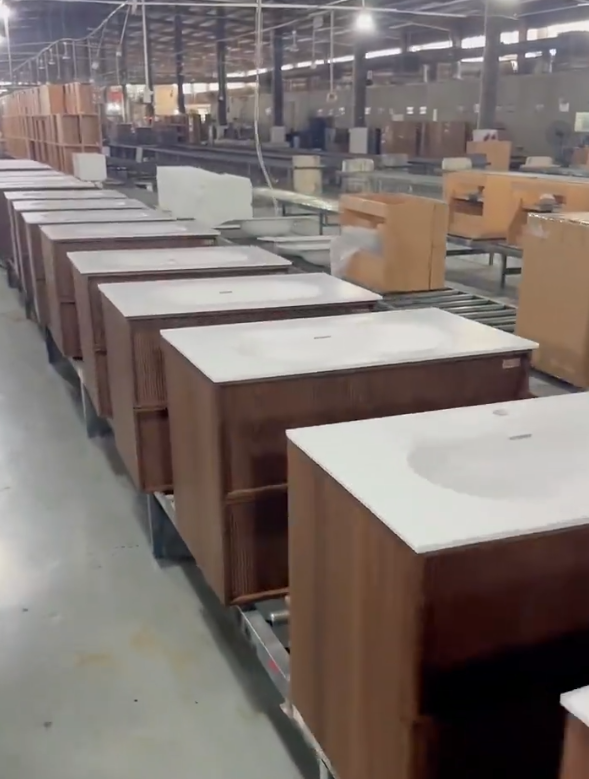
Foshan has a broad home-furnishing and building-material supply base, but a city name is not proof of a supplier’s capability. An effective on-site or live-video review follows one product, one order record and one process route. This guide helps bathroom buyers plan that review without relying on showroom impressions or unsupported facility claims.
Set the purpose before scheduling a visit
Decide which questions the review must answer. Early qualification may focus on commercial identity, product-process fit and control systems. A pre-order review may examine the proposed material, sample and packaging route. A pre-shipment visit may verify finished quantities and selected quality points. Combining every objective into an unstructured tour usually produces many photographs but few decisions.
Send an agenda in advance that names the exact models, requested records, people to attend and areas to view. Ask the host to state which activities happen at that location and which are completed by other sites or component partners. This allows the buyer to allocate time according to product risk.
Choose the right review format
| Format | Useful for | Important limitation |
|---|---|---|
| Document review | Entity, process, specification and record screening | Does not confirm current physical conditions |
| Live video walkthrough | Fast visual verification and follow-up questions | Camera view, sound and connectivity restrict inspection |
| Buyer site visit | Direct discussion and product/process sampling | Requires a structured checklist and informed reviewer |
| Independent audit | Defined criteria and third-party reporting | Scope must match the buyer’s actual risk |
| Pre-shipment inspection | Selected order conformity before dispatch | Cannot replace earlier specification control |
These formats can be combined. A document review can identify gaps before a live walkthrough, and the results can determine whether an on-site audit is needed. The choice should reflect order value, product complexity, destination requirements and consequences of failure.
Confirm location and identity at the opening
For a live video, ask the host to begin outside, show current signage and move continuously to the agreed areas where practical and safe. Confirm the date, location and participants on camera. For an on-site visit, reconcile the address and company name with the contracting and invoicing entities. If they differ, document the relationship.
Do not treat a busy workshop or large showroom as evidence of ownership, available capacity or order control. Record only what the review can establish. Ask whether the site is owned, leased, shared or operated by another related entity, and request supporting records if that distinction is material to the sourcing decision.
Follow one model from specification to packing
Select a proposed vanity or mirror before the review. Begin with its drawing and component schedule, then follow the actual route as far as possible. For a vanity, the route may include board or panel identification, machining, edge treatment, finish work, assembly, hardware fitting, top and basin coordination, inspection and packing. Some steps may occur elsewhere; mark them on the process map.
For an illuminated mirror, review glass processing, edge condition, backing, lighting and electrical assembly, powered testing, mounting components, labels and packing. Ask staff to distinguish the exact model from similar samples. The objective is not to photograph every machine; it is to verify that records, materials and checkpoints connect to the quoted configuration.
Sample records instead of accepting presentations
Ask to see a small sample of current records: incoming material identification, work instruction, in-process check, finished inspection, non-conformance disposition and packing approval. Personal or customer-confidential data can be redacted. Check whether records show a date, model or order reference, acceptance criteria, result and responsible reviewer.
Compare one work instruction with the controlled drawing you received. Ask how revised information reaches the work area and how obsolete versions are withdrawn. Then ask how an unapproved material or failed item is labelled and separated. A credible answer should be visible in the process, not only described in a meeting room.
Review component and sub-supplier control
Bathroom products often combine inputs from different specialists. A vanity may use purchased hardware, basin, countertop and packaging; a mirror may use a driver, lighting, sensor and glass from different sources. Ask how approved components are identified and what triggers buyer notification when availability changes.
If a critical step or component is outsourced, identify the responsible supplier and control method. The goal is not to demand that every input be produced under one roof. It is to understand who owns the specification, how incoming conformity is checked and whether substitutions require approval.
Examine quality points with defined criteria
A tour statement such as “quality is checked several times” is not specific enough. For the selected model, ask which features are checked, at what stage, with what tool or reference, and how results are recorded. Review dimensional, appearance, function, fit, electrical and packaging checks relevant to that product.
Ask to see how a non-conforming item moves through review, rework and reinspection. Sample a closed issue if available and appropriate. The effectiveness of correction matters more than the number of inspection stations shown on the tour.
Inspect packaging and shipment identity
Packaging should reflect the product’s weight, fragile areas, finish and shipment route. Review corner and surface protection, internal movement, hardware containment, moisture considerations, carton strength assumptions and pallet or crate use where applicable. Ask how packaging is approved and linked to the product revision.
Check a sample carton mark against the order line and packing list format. The receiving team should be able to identify model, quantity and carton sequence without opening every package. For project orders, confirm whether allocation codes are applied and controlled.
Use a disciplined live-video method
- Request a continuous route for key transitions instead of edited clips.
- Ask the camera operator to show wide context before close-up details.
- Use a second participant to manage the checklist and record questions.
- Ask for legible still images of documents after the live session.
- Do not request unsafe access or filming that exposes other customers’ data.
- Record unverified points and the evidence needed to close them.
Close the review with evidence and actions
Issue a short report separating observations, evidence, gaps and required actions. Avoid conclusions broader than the review scope. A walkthrough of one line on one day cannot prove total monthly capacity or future delivery performance. If scheduling is important, request order-loading and material-readiness evidence separately.
ArcQuay’s Foshan sourcing and verification page can help shape an initial agenda, while the product catalogue provides models to anchor a specific review. Include the chosen model, review purpose and preferred format when you send an enquiry.